Amazon Live: The Ultimate Tool for Brand Visibility and Real-Time Engagement

Amazon Live: The Ultimate Tool for Brand Visibility and Real-Time Engagement

Amazon Live has transformed how brands connect with their customers, offering a dynamic, interactive platform that brings product stories to life. And the best part? It’s completely free for brands to use, making it a golden opportunity to engage a large audience, showcase products in an authentic setting, and drive real-time sales. Here’s why Amazon Live should be part of every brand’s digital strategy and how to make the most of it.

Reach and Engage – For Free

Amazon Live is free to use, giving brands a unique way to showcase their products directly to potential buyers. For brands looking to stretch their marketing budgets, this free platform can amplify their reach without any additional costs. By broadcasting on Amazon Live, brands gain access to a vast, built-in audience actively seeking products.

Real-Time Customer Engagement

One of Amazon Live’s greatest strengths is its ability to provide real-time engagement. During a live session, customers can ask questions, get immediate answers, and learn about product features directly from the source. This live interaction creates a connection between the brand and its audience, instilling trust and making it easier to convert viewers into buyers.

Exclusive, Live-Only Promotions

Amazon Live offers brands the chance to run exclusive, live-only promotions, creating a sense of urgency for viewers. By offering discounts or special deals only available during the livestream, brands can boost conversions and incentivize viewers to tune in for future sessions, increasing repeat viewership.

Boost Brand Awareness and Discoverability

 In today’s competitive digital marketplace, discoverability is everything. Amazon Live is an ideal way to enhance brand awareness as it allows products to be seen by a broader audience in a format that captures attention. As viewers watch livestreams, they become more familiar with the brand, which helps drive long-term loyalty.

Educational and Inspirational Content

Brands aren’t limited to promoting products in a hard-sell format; they can also create educational and inspirational livestream experiences that add value for the viewer. For instance, a beauty brand could host a tutorial on skincare routines or a cooking brand might showcase creative recipes. These types of content build trust, showcase expertise, and foster deeper connections with the audience.

Shoppable Campaigns for Product Discovery 

Amazon Live integrates shoppable links into livestreams, making it simple for viewers to add products directly to their carts. This seamless shopping experience is perfect for driving product consideration, allowing customers to discover, engage, and purchase products all in one place.

Leverage Influential Creators

Amazon Live lets brands partner with creators who bring their own unique audiences and voices to the table. By working with popular creators, influencers, or brand ambassadors, brands can tap into new segments, increase social reach, and deliver authentic brand storytelling that resonates with viewers.

Flexible Scheduling with Pre-Recorded Content

Not all livestreams need to be, well, live. Amazon Live lets brands pre-record sessions, which can be scheduled to go live at a convenient time, allowing brands to plan and produce high-quality content that works for their schedule.

Tips for Making the Most of Amazon Live

To truly stand out on Amazon Live, brands should focus on a few essential strategies:

  1. Consistency is Key: Regular, scheduled live sessions help build an audience that knows when to tune in.
  2. Showcase Authenticity: Being genuine resonates. Don’t be afraid to be yourself and show the human side of your brand.
  3. Share Your Journey: Transparency and even a little vulnerability go a long way in building trust. Share your brand’s story, journey, and vision.

Why Amazon Live? The Numbers Don’t Lie

The impact of Amazon Live is hard to ignore. Nearly all Amazon Live viewers—96%—take some action with brands they watch, whether that’s learning more, adding products to their cart, or making a purchase. Additionally, two-thirds of Amazon Live shoppers enjoy discovering new products through creators, and 76% of sales from sponsored Amazon Live streams come from new-to-brand customers, showcasing Amazon Live’s power to bring in fresh audiences.

Partner with Experts for Success

Amazon Live has best-in-class production resources that brands can leverage for custom campaigns or integrations into existing Amazon Live programs. With expertise in live and shoppable content, The Machine Agency offers end-to-end creative asset development, from initial concept to live broadcast. Whether you’re aiming to educate, inspire, or entertain, our team knows how to craft experiences that deliver.

Ready to Go Live?

At The Machine Agency, we specialize in producing high-impact Amazon Live experiences that captivate audiences and convert viewers into lifelong customers. Reach out to explore how Amazon Live can elevate your brand’s digital presence and drive sales in an exciting, innovative way.

Amazon Introduces Low Inventory Level Fee to Encourage Stock Consistency

Amazon Introduces Low Inventory Level Fee to Encourage Stock Consistency
In a move that reflects its commitment to enhancing the customer experience, Amazon announced a significant update to its inventory management policies, effective April 1, 2024. The e-commerce giant will introduce a Low Inventory Level Fee aimed at sellers who struggle to maintain inventory levels that meet buyer demand. This initiative underscores Amazon’s efforts to ensure that its marketplace remains stocked with products customers need and want, without facing the frustration of frequently out-of-stock items.

Understanding the Low Inventory Level Fee

Amazon’s Low Inventory Level Fee is designed to incentivize sellers to keep a consistent stock of their products. The fee will be applied to standard-sized items which, over time, have consistently shown inventory levels that fall short of meeting buyer demand. Specifically, this fee targets items with both long-term (past 90 days) and short-term (past 30 days) historical days of availability of fewer than 28 days.

The “Historical Days of Availability” is a metric calculated by Amazon, taking into account the average daily number of items in stock. This figure is derived from the sellable inventory, volume of items delivered from warehouses, and reserved inventory, excluding unsellable items. Essentially, it’s a measure that helps Amazon gauge whether sellers are keeping up with the demand for their products.

Exemptions and Considerations

Notably, Amazon has outlined specific conditions under which sellers can be exempt from the Low Inventory Level Fee. These exemptions aim to support sellers in various stages of their journey on the Amazon platform, including:
 • New Professional sellers, who will be exempt for the first 365 days following their initial inventory receipt.
 • New-to-FBA (Fulfillment by Amazon) parent products, exempt for the first 180 days post their first inventory-received date, provided the sellers are enrolled in the FBA New Selection program.
 • Products automatically replenished by Amazon Warehousing & Distribution (AWD), recognizing the role of automated systems in maintaining optimal inventory levels.

Strategic Implications for Sellers

This policy update from Amazon has significant implications for sellers on the platform. It underscores the importance of inventory management as a critical aspect of e-commerce success. Sellers must now pay closer attention to their inventory trends over the past three months and the preceding month. By doing so, they can avoid the pitfalls of low inventory or stockouts, which would not only lead to the Low Inventory Level Fee but could also potentially harm sales and customer satisfaction.

Moreover, this move by Amazon highlights the increasing importance of sophisticated inventory planning and forecasting tools. Sellers are encouraged to leverage available technologies and Amazon’s own resources to better predict demand and plan their inventory accordingly.

In conclusion, Amazon’s Low Inventory Level Fee is a strategic initiative aimed at ensuring that its marketplace remains reliable and well-stocked, thereby enhancing the overall customer experience. Sellers, for their part, must adapt to these changes, focusing on improving their inventory management practices to avoid additional fees and meet the evolving expectations of Amazon and its customers.

The Impact on Vendor Central Sellers

The introduction of Amazon’s Low Inventory Level Fee is not just a consideration for third-party sellers; it also holds significant implications for Vendor Central sellers. Those who sell directly to Amazon, acting as suppliers to the e-commerce giant, must also be vigilant in maintaining adequate inventory levels to meet Amazon’s purchasing demands. For Vendor Central sellers, this new fee underscores the importance of forecasting, production planning, and timely logistics to ensure that Amazon’s orders can be fulfilled without delay. Failure to do so could result in financial penalties, strain the relationship with Amazon, and ultimately impact the visibility and sales of their products. This policy change serves as a reminder to all vendors of the critical role inventory management plays in sustaining a successful partnership with Amazon, urging them to adopt more strategic and efficient inventory practices.

Need Assistance with Your Amazon Inventory Management?

Navigating the complexities of Amazon’s new Low Inventory Level Fee and its implications for inventory management can be challenging for many sellers. Staying ahead in the ever-evolving e-commerce landscape requires a deep understanding of Amazon’s policies, strategic inventory planning, and the ability to adapt quickly to changes.

If you find yourself struggling to maintain optimal inventory levels or are seeking ways to avoid the new fees while maximizing sales and customer satisfaction, The Machine Agency is here to help. Our team of experts specializes in Amazon sales strategies, inventory management, and compliance with Amazon’s policies. We offer tailored solutions to ensure your business not only meets Amazon’s requirements but thrives on the platform.

Whether you’re a new seller on Amazon looking to navigate the early days of your business or an experienced merchant facing challenges with the new inventory fee, The Machine Agency can provide the guidance and support you need. Our services include inventory forecasting, strategic planning, compliance advice, and much more. Let us help you optimize your Amazon operations, avoid unnecessary fees, and drive your business towards greater success.

Contact The Machine Agency today at info@themachineagency.com, and let’s work together to make your Amazon selling experience smooth, profitable, and compliant with the latest policies. Our team is ready to assist you in taking your Amazon business to the next level.

How TMA Drives Amazon Sales with SEO Funnels

How TMA Drives Amazon Sales with SEO Funnels

Search Engine Optimization (SEO) attracts targeted search traffic that is likely to convert. The Machine Agency (TMA) does this by creating relevant, optimized articles to address prospects’ needs and questions.

Executive Summary

• TMA’s Content Marketing leads the customer through 3 funnel stages: Awareness, Consideration and Conversion.
• TMA uses data from your Amazon sales to create content tailored to customer needs, questions and search intent.
• TMA uses proprietary software to create, monitor and refine your campaigns to increase conversion in each funnel phase.
• Content Marketing increases Amazon sales and cuts your ad budget by driving traffic to your listing with zero PPC cost.

Understanding SEO and Its Importance

SEO, or Search Engine Optimization, aligns your content with what search engines value and what your audience seeks.
TMA starts with a substantial advantage: DATA. Your Amazon campaigns are already tracked by our custom-built software, giving you an unfair advantage you can now apply to Google.
We use this in-house data to create targeted content that satisfies Search Intent. Search Intent is what users are actively looking for when they type a query.
Matching your content to this intent raises your appearance in search results, which drives page traffic, brand awareness, and new customers.


The Stages of the SEO Funnel

Top of the Funnel: Awareness

At the top of the funnel, your goal is to generate awareness. Your content should be designed to educate and inform, focusing on broad topics related to your industry.

Why publish on OTHER sites? We publish on sites with strong traffic to: drive referral traffic to your site, expand your brand’s visibility to new customers, and to raise your rank in search results.
Find and Engage Customers: We tailor your content to the questions, needs, and interests of your readers while establishing a helpful relationship with the publishing site
Obtain Backlinks: Backlinks are links from other websites back to content on your website. These are a crucial signal to Google, and buoy your site’s search rank quickly
Content type: Blog posts and infographics on Other Sites
Keywords: Broad, informational, inspirational, fun
Objectives: Expand brand presence, widen funnel and secure a link back to Your Site
Example: Ways to Incorporate Fasion into Home Decor

Middle of the Funnel: Consideration

During the mid-funnel Consideration phase, your audience is considering whether your offer fits their needs. Your content here should go deeper into specific features, benefits, and pain points.
To captivate your audience, blog posts should deliver value and resonate with the interests of your readers. Here’s how you can make them more engaging:
Engage Your Audience: Tailor your content to their questions, needs, and interests
Present Your Call to Action: While educating your audience, present your solution
Content types: Blog posts and infographics on Your Site
Keywords: More focused, problem-solving, technical
Objectives: Address specific user problems, provide comparison, prevent returns
Example: How to Clean Bed Pillows

Bottom of the Funnel: Conversion

At the base of your funnel are commerce-focused Landing pages that guide visitors toward a desired action. We feature persuasive, conversion-focused content to reassure users that your product is the right choice and to proceed with checkout, either on your site or on Amazon.
Focus on the Sale: We ensure your message is clear with a compelling call to action (CTA).
Visually Appealing: We use design strategies that direct attention to the CTA while
providing a pleasant user experience. This page is concise and focused on the CTA.
Content types: Testimonials, product demos, free trials, can be an Amazon page
Keywords: High intent, transactional
Objective: Encourage action and close the sale
Example: 30 Best Cozy Throw Pillows

Frequently Asked Questions

What metrics are important for monitoring the top of the funnel in SEO?

Important metrics for the top of the funnel in SEO include website traffic, click-through rates, bounce rates, and indexed pages. TMA uses these and dozens of other indices to gauge effectiveness.

Can you provide some examples of successful SEO funnels?

Successful SEO funnels in digital marketing feature a synergy between high-quality content, strategic keyword targeting and user-friendly website design to engage and move readers through the funnel stages. Here are two examples:

Services and Products

Awareness: https://www.soundtrap.com/content/blog/audio-formats-explained

Consideration: https://teropotila.com/how-to-produce-music

Conversion: https://teropotila.com/best-computers-for-music-production

Law and Software-as-a-Service (SAAS)

Awareness: https://www.lawinsider.com/resources/contributors/lisa-wilcox

Consideration: https://lisareneewilcox.com/texas-remote-online-notarization

Conversion: https://lisareneewilcox.com/contact

What are the key stages along an SEO marketing funnel?

Awareness, where potential customers first encounter your content; Consideration, where you pique their curiosity with more detailed information; Conversion, where they become customers.

In what ways does an SEO funnel differ from a traditional sales funnel?

TMA’s SEO sales funnel drives your organic traffic and brand visibility. We emphasize content value and user experience as key drivers at each stage, rather than direct sales pressure.

How does SEO integrate with other channels in a comprehensive marketing funnel strategy?

Content is King. Whether you focus on Amazon traffic, social media, email marketing or paid advertising, you need content that engages and motivates your readers.

SEO integrates particularly well with Amazon, as the Amazon page for your products can serve as the Landing Page at the base of your funnel. SEO augments your current processes and success.
Knowledge is your Company, Products are your Transaction, Content Marketing Elevates Both.

Mastering Amazon: The Machine Agency’s WINNING Strategy for US Market Entry

Mastering Amazon: The Machine Agency’s WINNING Strategy for US Market Entry

Introduction

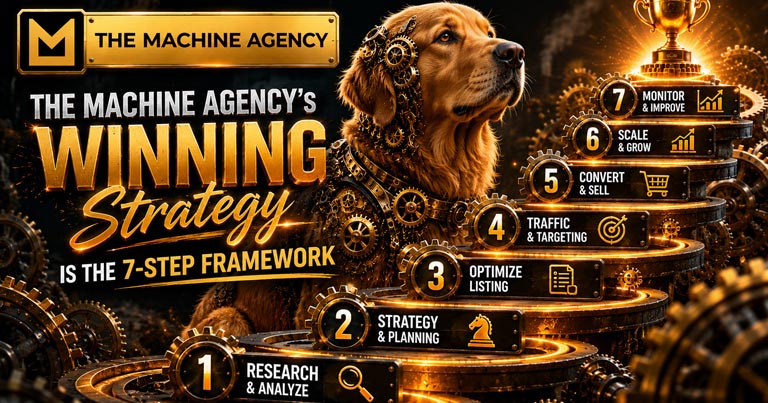
For brand owners eyeing the lucrative US market, the path to success on Amazon can seem daunting. That’s where The Machine Agency steps in, transforming challenges into triumphs. Our unique WINNING Strategy Process, crafted by Cash Riley Jr., is more than a success formula; it’s a testament to our dedication in making your brand a powerhouse in the US market.

Why The Machine Agency?

As a brand owner, you want more than just promises; you need results. At The Machine Agency, we don’t just talk about success – we create it. Our track record in expanding brands into the US market through Amazon speaks volumes. It’s not just about entering the market; it’s about dominating it.

The WINNING Strategy Process: Your Blueprint to Success

🌟 W – Watchful Market Analysis:
Understanding the US market is key. We don’t just follow trends; we predict and act on them, keeping your brand ahead.

🌟 I – Innovative Optimization:
Every aspect of your Amazon presence, fine-tuned for peak performance – that’s our promise.

🌟 N – Nuanced Advertising:
Our advertising strategies on Amazon aren’t just effective; they’re transformative, ensuring your brand connects with the American audience.

🌟 N – Network Growth:
Expanding into the US isn’t just about selling; it’s about building lasting relationships. We grow networks that grow brands.

🌟 I – Integrated Technology:
Using the latest tech, we ensure your brand’s Amazon operations are seamless, efficient, and always ahead of the curve.

🌟 N – Navigational Excellence:
Navigating Amazon’s complexities? Leave it to us. We guide you through, ensuring a smooth journey to success.

🌟 G – Goal-Oriented Strategies:
Your ambitions are our commands. Every step we take is aligned with your brand’s goals for the US market.

    Beyond Strategy: A Partnership for Success

    Choosing The Machine Agency means you’re not just getting a service; you’re gaining a partner dedicated to your brand’s growth. We don’t rest until your brand reaches the heights you’ve envisioned. Remember, ‘the machine never stops’.

    Hashtag Heaven

    #TheMachineAgency #AmazonSuccess #USMarketExpansion #WINNINGStrategy #EcommerceExcellence #BrandGrowth #CashRileyJr #USExpansion #AmazonMarketing

    Your Brand’s US Journey Begins Here

    Ready to conquer the US market with a partner who understands your vision and has the expertise to make it a reality? Let’s connect and discuss how The Machine Agency can make your brand the next big thing in the US.

    Discover Your Brand’s Potential with The Machine Agency

    Embark on a journey with The Machine Agency, where your brand’s US market success on Amazon is not just a possibility – it’s a promise. With our WINNING Strategy Process and a commitment that ‘the machine never stops’, your brand is set for an unparalleled trajectory of growth and dominance.

    Updates to Amazon’s Handling Time for Fulfilled by Merchant Brands

    Updates to Amazon’s Handling Time for Fulfilled by Merchant Brands

    Introduction

    Amazon has introduced significant updates to its handling time management for sellers who fulfill their own orders, particularly beneficial during the high-volume holiday season. These enhancements aim to present more precise delivery estimates to shoppers, potentially increasing sales for brands.

    Understanding Automated Handling Time

    Automated handling time, a feature determining handling times for each SKU based on historical performance, has been improved in the following ways as of September 2023:

    Same-Day Handling Time: This update applies a same-day handling time for SKUs dispatched on the order day, ensuring more accurate delivery predictions.

    Handling Capacity Override: Sellers can now manually adjust the automated order-handling capacity, derived from past performance, if their operational capabilities have improved.

    Reverting Option: Opting out of automated handling time will reset the SKU-specific handling time to its prior state, allowing sellers to experiment with the feature without losing their original settings.

    Amazon’s New Approach to Default Handling Time

    Amazon has removed the 2-day default handling time option for brands in the Fulfilled by Merchant program. This change reflects the fact that 85% of sellers fulfill orders within a day. The implications are as follows:

    • 2-Day Handling for Specific SKUs: For SKUs historically taking over a day to process without a set SKU-level handling time, Amazon will automatically apply a 2-day handling time, overriding the default.

    • 1-Day Default Handling Time: SKUs historically processed in a day or less, without a specific handling time, will adhere to the updated 1-day default.

    • No Change for Existing SKU-Specific Times: SKUs with pre-set specific handling times remain unaffected.

      Additional Flexibility for Brands

      Brands can set an Order Handling Capacity to buffer against order influxes. They can also define SKU-specific Handling Times, useful for products requiring more than a day for dispatch. This customization allows brands to maintain a balance between operational efficiency and customer expectations.

      TMA Analysis

      Amazon’s move towards shorter, more precise Handling Times aligns with the trend of brands often setting needlessly extended times. This habit leads to shoppers seeing longer estimated delivery dates. By fine-tuning these settings, especially for key SKUs during the holiday season, brands can make their offers more appealing, potentially boosting sales. The Machine Agency advises a thorough review of Handling Time settings across your FBM catalog to optimize for the upcoming seasonal rush.

      Beyond Reviews: The New Paradigm to Drive Sales on Amazon

      Beyond Reviews: The New Paradigm to Drive Sales on Amazon

      Introduction

      In the not-so-distant past, reviews on Amazon acted as the north star for potential customers. A high number of positive reviews almost guaranteed an influx of sales, and many brands believed that the more reviews they accumulated, the higher their chances of success. However, as with many things on the internet, this system found its loophole exploiters.

      The proliferation of fake reviews and seller-generated feedback has caused consumers to approach these once-trusted testimonies with skepticism. The Amazon review system, though still valuable to some extent, no longer holds the credibility it once did. So, what’s the way forward for brands wanting to establish trust and drive sales on Amazon?

      The Age of Community-Driven Brands

      Enter the era of community-driven brands. As the proverb goes, “It takes a village to raise a child,” similarly, it takes a community to uplift a brand to the pinnacle of success. Building a brand isn’t just about selling a product anymore; it’s about establishing a tribe of loyal followers whose opinions are revered and trusted.

      Why Community Matters More Than Ever

      Authenticity: Communities aren’t built overnight. They’re nurtured over time through genuine interaction, understanding, and mutual respect. A well-engaged community reflects the brand’s authenticity, making its recommendations more trustworthy.

      Feedback Loop: Instead of sifting through potentially fake reviews, brands can tap into their community for genuine feedback, ensuring that products evolve according to real consumer needs.

      Word-of-Mouth: Personal recommendations have always been powerful. A recommendation from someone within a trusted community carries significant weight. When members of your brand’s community share their positive experiences, it resonates more authentically than any Amazon review ever could.

      Harnessing the Power of Community

      For brands looking to thrive on platforms like Amazon, here are a few steps to cultivate and leverage your community:

      1. Engage Beyond Selling: Use platforms like social media, forums, and newsletters to engage with your audience. Share stories, address concerns, and celebrate successes together.

      2. Create Exclusive Experiences: Offer your community exclusive deals, sneak peeks, or opportunities to test new products. Make them feel valued.

      3. Encourage Sharing: Motivate your community members to share their experiences and stories. When genuine stories are shared, they have the potential to influence far more than any fabricated review.

      Conclusions

      In conclusion, while reviews on Amazon will always have some influence, the era of community-driven brands is upon us. Brands that understand the value of genuine community interactions and can harness its power will undoubtedly have an edge in the market. Let your community be the genuine voice of your brand, and let their trusted opinions drive your success on Amazon.