Inventory Planning for Pet Brands: How to Avoid Stockouts During Peak Season

Inventory Planning for Pet Brands: How to Avoid Stockouts During Peak Season

Cash Riley Jr.
Founder & CEO, The Machine Agency, Dallas, Texas

Running out of stock on Amazon is more damaging than most pet brands realize. Here is how to plan inventory strategically so you never lose your ranking at the worst possible time.

Of all the operational challenges pet brands face on Amazon, inventory planning is the one most likely to undo months of hard work in a matter of days. A stockout does not just cost you immediate sales – it sets your organic ranking back, increases your advertising costs to rebuild momentum, and hands market share to competitors who were prepared when you were not.

How Stockouts Damage Your Ranking

Amazon’s algorithm rewards in-stock reliability. When you run out of stock, your listing either goes inactive or displays as unavailable. During that window, your organic ranking decays – sometimes rapidly, depending on how competitive your category is.

When you restock and reactivate, you do not pick up where you left off. You are starting the ranking rebuild process from a lower position, which means more advertising spend to regain visibility. The true cost of a stockout extends far beyond the sales lost during the out-of-stock window.

Build a Demand Forecast

Effective inventory planning starts with accurate demand forecasting. For most pet brands, this means looking at three data sets: historical sales velocity, seasonal trends in your category, and the impact of your planned promotions and advertising campaigns.

Your historical velocity tells you what you have sold in comparable time periods. Amazon’s Brand Analytics tools can show you seasonal trends in your category. And your promotional calendar tells you when you are planning to accelerate sales, which will consume inventory faster than your baseline forecast.

Account for Amazon’s Lead Times

One of the most common inventory planning mistakes is underestimating the time it takes to get product into FBA. Amazon’s inbound receiving can take anywhere from several days to several weeks during peak periods. If you are waiting until you are nearly out of stock to send your next replenishment, you are planning to fail.

Build your replenishment triggers around realistic lead times – not best-case scenarios. Account for production time, shipping time, and FBA processing. Build in buffer stock that covers you if any of those timelines extend.

Plan for Peak Season Early

For pet brands, the calendar has predictable high-demand periods: the holiday season, the spring pet adoption surge, Prime Day, and summer. The mistake most brands make is treating peak season preparation as something they will get to. By the time they think about it, their production slots are taken, their freight options are limited, and they are scrambling to avoid a stockout during the highest-volume period of the year.

Effective brands treat peak season inventory planning as a strategic function that starts 90 to 120 days before the peak. That timeline gives you enough runway to order production, ship product, and get inventory into FBA before the rush begins.

Use Amazon’s Data Tools

Amazon provides inventory-related data in Seller Central that most brands underutilize. The Inventory Performance Index score, the Days of Supply metric, and the Restock Recommendations report all give you actionable information about the health of your inventory position.

Pay particular attention to your Days of Supply metric. Amazon’s algorithm flags listings with low days of supply for potential suppression. Keeping this metric healthy is both an operational necessity and a ranking strategy.

    The Bottom Line

    Inventory planning is not glamorous – but it is the foundation everything else is built on. Brands that get it right have a compounding advantage: their ranking stays strong, their advertising efficiency improves, and their customer experience is consistent.

    TMA manages inventory planning and FBA strategy for pet and consumer brands. Schedule a free audit at themachineagency.com/free-amazon-audit to review your current inventory position.

    $20,000+ Recovered. $0 → $750,000 and Growing.

    $20,000+ Recovered. $0 → $750,000 and Growing.

    Suspended, Frozen, and Starting From Zero. Here Is What Happened Next.

    Account Reinstated. $20,000+ Recovered. $0 → $750,000 and Growing.

    Consumer Home Goods | Founding TMA Client

    The Challenge

    A home goods brand with a quality product and a loyal customer base had no Amazon revenue — not because demand was absent, but because their account had been suspended. When TMA first engaged with this brand as one of its founding clients, they were locked out of the platform entirely. Worse, over $20,000 in funds were sitting frozen inside the account — inaccessible, with no clear path to recovery.

    An Amazon suspension is one of the most disorienting situations a brand can face. The platform provides limited transparency into the reason, appeals are notoriously difficult to navigate, and every day the account stays dark is a day of lost revenue that cannot be recovered. For most brands, suspension becomes a slow exit from the marketplace. For this brand, it became the beginning.

    The Approach

    TMA’s first priority was reinstatement. That meant building a comprehensive appeal — identifying the root cause of the suspension, documenting a credible corrective action plan, and presenting it to Amazon in the structured format that the platform’s Seller Performance team responds to. This is not a process that benefits from urgency or emotion. It requires precision, patience, and an understanding of how Amazon’s internal review process works.
    The appeal was successful. The account was reinstated.

    Immediately following reinstatement, TMA turned its attention to the frozen funds — more than $20,000 held inside the account that Amazon had not disbursed during the suspension period. Recovering these funds required opening and managing cases with Amazon Seller Support, providing documentation, and following up persistently until the full balance was released back to the brand.

    With the account live and the funds recovered, TMA began building the brand’s Amazon presence from the ground up. Product listings were created and optimized with the same discipline TMA applies across its full client portfolio — SEO-driven titles, benefit-led content, professional imagery, A+ Content, and a backend keyword strategy designed to build organic rank from day one.

    Advertising was introduced strategically, starting with controlled Sponsored Products campaigns targeting high-intent, category-specific keywords. As the account aged and organic rank developed, campaign structure expanded. Bids were managed actively. Keywords that proved profitable were harvested into manual campaigns. Spend was scaled in proportion to performance — never ahead of it.

    Inventory planning was built into the operational rhythm early, ensuring the brand maintained consistent in-stock status as the account gained momentum. A single stockout during the early growth phase can set organic ranking back weeks. TMA’s approach treats inventory as a strategic asset, not an afterthought.

    The Result

    In the first year following reinstatement, the brand grew from zero to over $100,000 in Amazon revenue. The account that had been suspended and frozen became a functioning, growing business channel.

    Year over year, the momentum compounded. Revenue grew to $250,000. Then the brand crossed $350,000 and continued scaling, reaching $750,000 in annual Amazon revenue — a figure that would have been unimaginable at the moment the suspension notice first arrived.

    Over $20,000 in frozen funds were fully recovered. A brand that had been locked out of the world’s largest marketplace was not just reinstated — it was rebuilt into a consistently growing Amazon business.

    What It Proves

    An Amazon suspension is not a death sentence — it is a solvable problem. But solving it requires expertise that most brands do not have in-house and cannot improvise under pressure. TMA has navigated reinstatements, fund recoveries, account health crises, and listing suppression events for brands across categories. The operational depth that makes TMA effective is not just about driving growth — it is about protecting and restoring what brands have already built, and then building further from there.

    This brand did not just survive an Amazon suspension. With TMA, they used it as a starting line.

    Conversion Rate: 28% → 76% | 5 Months

    Conversion Rate: 28% → 76% | 5 Months

    Nearly Three Times the Conversion Rate. Same Traffic. Same Price. Different Everything Else.

    The Challenge

    A pet supplement brand was driving consistent traffic to their Amazon listings but losing the vast majority of it. Their conversion rate sat at 28% — meaning nearly three out of every four shoppers who clicked on their product left without buying. In a category where customer intent is high and purchase decisions are emotionally driven, a 28% conversion rate signals a trust problem, not a traffic problem.
    The brand had invested in driving visibility. What they had not invested in was giving customers a reason to buy once they arrived.

    The Approach

    TMA conducted a full listing audit and identified the root causes of the conversion gap. The hero image was not immediately communicating the product’s purpose or differentiator. The bullet points were leading with ingredients rather than outcomes — describing what the product was rather than what it would do for a pet owner’s dog or cat. There was no A+ Content and no Brand Story, leaving the bottom of the detail page empty at exactly the moment the customer was deciding whether to trust the brand.

    TMA rebuilt every customer-facing element of the listings with conversion as the singular objective.

    The hero image was redesigned to lead with the pet and the outcome — communicating the product’s benefit before a single word was read. A full image stack was developed: lifestyle photography showing real pets, benefit-driven infographics, ingredient transparency graphics, and a comparison module positioning the brand against category competitors.

    Bullet points were rewritten using a benefit-first framework. Every bullet answered the question a pet owner actually asks: will this work for my dog? Is it safe? Why is this better than what I’m already buying?

    A+ Content was built to tell the brand’s story, address the most common objections, and walk the customer through the science behind the formulation in a way that built confidence rather than confusion. Brand Story was activated to introduce the brand’s mission, display the full catalog, and give first-time visitors a reason to trust before they bought.

    The Q&A section was seeded with the questions TMA’s category research identified as conversion blockers — and answered in a way that removed hesitation rather than deflecting it.

    The Result

    Within five months, the brand’s conversion rate climbed from 28% to 76% — nearly tripling on the same traffic, at the same price point, in the same competitive category. The improvement was driven entirely by changes to the listing itself. No additional advertising spend. No price adjustments. No promotions.

    At a 76% conversion rate, the brand was now converting at more than double the Amazon category average for pet supplements. Every dollar of existing advertising spend became significantly more efficient overnight. Every organic impression drove more revenue. The economics of the entire account shifted.

    What It Proves

    Conversion rate is the multiplier on everything else. A brand running ads at a 28% conversion rate is paying for three times as many clicks as it needs to. A brand that fixes its conversion rate before scaling its advertising budget does not just grow — it grows profitably. TMA optimizes the foundation before accelerating the spend. That sequence is the difference between growth that compounds and growth that costs.

    18,663% YoY Revenue Growth | $3,468 → $650,915/Month

    18,663% YoY Revenue Growth | $3,468 → $650,915/Month

    From $3,000 a Month to $650,000 a Month. In One Year. Without Paid Advertising.

    The Challenge

    A pet supplement brand came to TMA generating just over $3,400 per month on Amazon — enough to confirm there was demand, but nowhere near the revenue their product quality and brand potential deserved. Their listings were underoptimized, their keyword footprint was narrow, their images were not converting, and they had no structured strategy for organic ranking. They were essentially invisible in one of the fastest-growing categories on Amazon.

    The Approach

    TMA began with a full Watchful Market Analysis — mapping category demand, keyword search volume, competitor pricing, and the organic ranking gaps that represented the brand’s fastest path to visibility. What we found was significant: the brand had strong product fundamentals but was indexed for a fraction of the keywords its competitors were winning.

    From there, TMA executed a comprehensive listing overhaul. Titles were restructured for Amazon’s algorithm. Bullet points were rewritten to lead with benefits rather than features. A+ Content and Brand Story modules were built from the ground up, transforming the detail page from a generic product listing into a brand experience that built trust and drove conversion.

    Backend keyword strategy was layered in across every ASIN, dramatically expanding the brand’s organic search footprint without a single dollar of advertising spend. TMA’s content and SEO work alone began moving the ranking needle within weeks.

    Inventory planning was tightened to maintain consistent in-stock status — because stockouts kill organic rank, and organic rank was the engine driving this growth. Amazon’s algorithm rewards reliability. TMA built the systems to deliver it.

    The Result

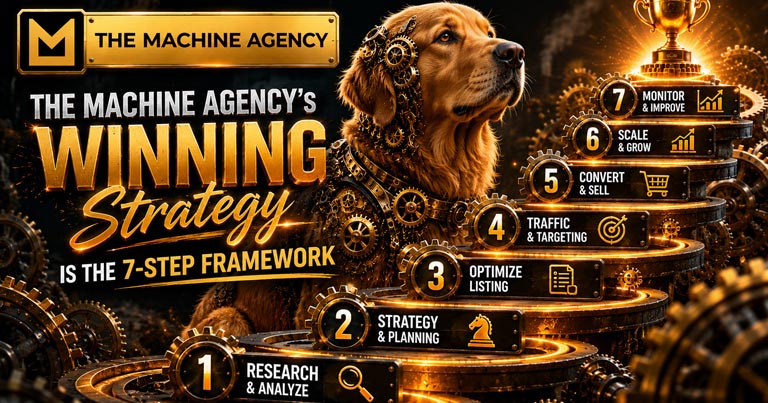
    Twelve months after engaging TMA, the brand was generating $650,915 per month — an increase of 18,663% year-over-year. That growth was achieved entirely through organic optimization: no paid advertising, no promotions, no external traffic sources. Just disciplined execution of the WINNING Strategy applied to a brand that had the right product and finally had the right partner.

    What It Proves

    Paid advertising can accelerate growth, but it cannot manufacture it. The foundation of sustainable Amazon revenue is organic rank — and organic rank is earned through superior content, intelligent keyword strategy, and operational consistency. TMA builds that foundation first. Everything else compounds on top of it.