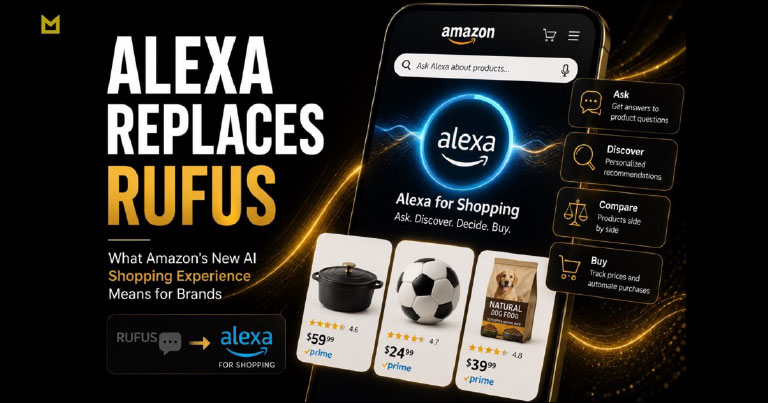
How to Optimize Your Amazon Listings for Rufus – Amazon’s AI Shopping Assistant

How to Optimize Your Amazon Listings for Rufus – Amazon’s AI Shopping Assistant

Cash Riley Jr.
Founder & CEO, The Machine Agency, Dallas, Texas

Amazon’s AI shopping assistant Rufus is changing how customers discover products. Here is what pet and consumer brands need to know to stay visible and win more sales.

If you have been managing an Amazon business for any length of time, you are used to the algorithm changing. But what Amazon introduced with Rufus is something different — and if you are not paying attention to it, your listings may already be losing ground.

Rufus is Amazon’s AI-powered shopping assistant, built directly into the Amazon app and shopping experience. Customers can ask Rufus conversational questions –

“What should I look for in a joint supplement for dogs?” or “Which cat food is best for indoor cats with sensitive stomachs?”

— and Rufus surfaces product recommendations based on its understanding of your listing content.

This is a meaningful shift in how customers discover products on Amazon. And it means your listing optimization strategy needs to evolve.

What Rufus Looks At

Rufus does not simply scan your title and bullet points the way the traditional A9 algorithm does.

It reads your listing holistically — including your product description, A+ Content, customerreviews, and Q&A section — and uses all of that information to determine whether your product is the right answer to a customer’s question.

That means listings optimized for keyword density alone may underperform in a Rufus environment. What Rufus rewards is clarity, context, and relevance.

    How to Optimize for Rufus

    Write for questions, not just keywords. Think about what your target customer is actually asking.

    A pet supplement brand should not just target “dog hip and joint supplement” – they should also address “what helps dogs with arthritis pain?” and “what ingredients support joint health in senior dogs?” Incorporate natural-language phrases like these into your bullets and description.

    Strengthen your A+ Content. Rufus reads A+ Content. If your enhanced content is thin or generic, you are leaving visibility on the table. Use it to explain the science behind your product, address common concerns, and answer the questions customers would ask Rufus directly.

    Keep your Q&A current and complete. The Q&A section is underutilized by most sellers, but it is rich content for Rufus. Answer every customer question on your listing and add your own Q&As if the section is sparse.

    Use your product description strategically. Many sellers neglect the product description in favor of bullets and A+ Content. For Rufus, a well-written description that explains use cases, benefits, and differentiators adds meaningful context that improves discoverability.

    Earn reviews that contain relevant language. Rufus surfaces review content. Customers who describe specific benefits in their reviews – “my 11-year-old Lab stopped limping after two weeks” – are helping Rufus connect your product to the right search queries. This makes your review generation strategy more important than ever.

      The Bottom Line

      Amazon is investing heavily in AI as the primary layer between customers and products. Rufus is not a gimmick – it is the direction the platform is moving in. Brands that optimize for this environment now will have a significant advantage over those still writing listings the same way they were three years ago.

      Ready to see how your listings perform against Amazon’s latest algorithm? Schedule your free Amazon audit at themachineagency.com/free-amazon-audit and we will show you exactly where the gaps are.

      Amazon vs. Walmart: Which Marketplace Should Your Pet Brand Prioritize in 2026?

      Amazon vs. Walmart: Which Marketplace Should Your Pet Brand Prioritize in 2026?

      Cash Riley Jr.
      Founder & CEO, The Machine Agency, Dallas, Texas

      Amazon and Walmart.com are the two dominant e-commerce platforms for pet brands. Here is how to think about which one deserves your focus – and when it makes sense to operate on both.

      If you are a pet or consumer product brand selling online, the Amazon versus Walmart question is coming up more frequently than it did even two years ago. Walmart.com has invested heavily in its marketplace infrastructure, and its seller base and sales volume have grown significantly. But Amazon remains the dominant force in e-commerce.

      So which should you prioritize — and does the answer depend on your specific situation?

      The Case for Amazon First

      For most pet brands, Amazon remains the primary opportunity. The platform has over 300 million active customer accounts worldwide, a deeply embedded shopping habit, and a fulfillment infrastructure that gives small and mid-size brands access to fast, reliable delivery without building their own logistics operation.

      Amazon’s advertising ecosystem is also significantly more mature. Sponsored Products, Sponsored Brands, Sponsored Display, and Amazon DSP give brands a full advertising funnel with robust reporting and attribution. The ability to see exactly how ad spend translates to sales – and at what cost – makes Amazon a measurable, manageable channel.

      Pet products is one of the fastest-growing categories on Amazon, with strong year-over-year volume growth across supplements, food, accessories, and health products. If you are building a marketplace-first strategy, Amazon’s ceiling is high.

      The Case for Walmart

      Walmart.com’s greatest strength is access to a customer segment that shops differently than the average Amazon customer. Walmart shoppers tend to be more value-oriented and loyal to brands they already know from brick-and-mortar retail. For pet brands with existing retail distribution, Walmart.com can be a natural extension of that presence.

      Competition on Walmart is also meaningfully lower than on Amazon in most pet categories. That means it is often easier and less expensive to achieve visibility on Walmart – at least for now.

      That window will not last forever as more brands recognize the opportunity.

      Walmart also provides strategic value for brands that want to diversify their marketplace exposure. Over-reliance on a single platform is a genuine business risk, and Walmart offers a meaningful alternative channel.

      How to Think About Both

      The approach TMA typically recommends is an Amazon-first strategy with Walmart as a structured secondary investment. Establish strong foundations on Amazon – optimized listings, active advertising, healthy review velocity, stable inventory — and then layer in Walmart once those systems are in place.

      Trying to scale both simultaneously without the operational bandwidth to manage both well often results in mediocre performance on both platforms.

      The one exception: if your brand has significant existing Walmart retail presence, launching on Walmart.com alongside Amazon can make strategic sense, since you can leverage your existing brand equity with that customer base.

        The Bottom Line

        Amazon should be the primary focus for most pet brands in 2026. Walmart is a legitimate and growing channel that deserves a place in your long-term strategy – but not at the expense of building a strong Amazon foundation first.

        TMA manages Amazon and Walmart for pet and consumer brands. Schedule a free consultation at themachineagency.com/free-amazon-audit to talk through your marketplace strategy.

        The True Cost of a High ACoS: How Pet Brands Are Quietly Losing Margin on Amazon

        The True Cost of a High ACoS: How Pet Brands Are Quietly Losing Margin on Amazon

        Cash Riley Jr.
        Founder & CEO, The Machine Agency, Dallas, Texas

        ACoS is one of the most watched metrics in Amazon advertising – but most pet brands are misreading it. Here is what it actually tells you and how to use it to protect your margin.

        Advertising Cost of Sales. ACoS. If you are selling on Amazon, you know the metric. You probably check it regularly. You may even have a target ACoS you are working toward. But there is a good chance you are not using it the way it was designed to be used — and that gap is quietly eroding your margin.Here is what most pet brands get wrong about ACoS, and how to fix it.

        What ACoS Actually Measures

        ACoS is the ratio of your Amazon ad spend to the revenue that ad spend generated. If you spend $100 on ads and those ads generate $400 in sales, your ACoS is 25%.

        What ACoS does not tell you is whether that 25% is good or bad. That depends entirely on your unit economics — your product cost, your FBA fees, your referral fees, your return rate, and your desired profit margin.

        A 25% ACoS on a product with a 60% gross margin is a profitable campaign. A 25% ACoS on a product with a 20% gross margin is a money-losing one. The metric is the same. The outcome is completely different.

        Your Break-Even ACoS

        Every product you sell on Amazon has a break-even ACoS — the point at which your ad spend exactly consumes your available margin. If your ACoS exceeds your break-even, you are losing money on every advertised sale.

        To calculate it: take your gross margin percentage after all Amazon fees and cost of goods. That number is your break-even ACoS. If your product sells for $30, costs $8 to produce, and your Amazon fees total $9, your gross margin is $13 — roughly 43%. Any campaign running above a 43% ACoS is operating at a loss.

        The Mistake Most Pet Brands Make

        Most pet brands set ACoS targets based on benchmarks they read somewhere – “20% is good” or “30% is acceptable” – without anchoring those targets to their actual unit economics.

        The result is that brands running at “acceptable” ACoS levels are often losing money without knowing it. And brands fixated on driving ACoS below a generic target are sometimes cutting off profitable campaigns in the process.

        What to Do Instead

        Calculate your break-even ACoS for every product in your catalog. This is not a one-time exercise – it needs to be updated when your costs change. Separate your awareness campaigns from your conversion campaigns. A top-of-funnel Sponsored Brands campaign may warrant a higher ACoS than a Sponsored Products campaign targeting high-intent keywords. Blending them into a single ACoS target obscures what isactually performing.

        Consider Total Advertising Cost of Sales (TACoS) – the ratio of ad spend to total revenue including organic sales. TACoS gives you a more complete picture of how your advertising investment is contributing to your overall business, not just ad-attributed revenue.

          The Bottom Line

          ACoS is a useful metric, but only when anchored to your actual economics. If you do not know your break-even ACoS for every product you are advertising, you do not have a complete picture of whether your campaigns are making you money or costing you money.

          TMA conducts profitability analysis as part of every engagement. Schedule a free Amazon audit at themachineagency.com/free-amazon-audit to see where your advertising margins really stand.

          A+ Content vs. Brand Story: Which Actually Drives More Sales on Amazon?

          A+ Content vs. Brand Story: Which Actually Drives More Sales on Amazon?

          Cash Riley Jr.
          Founder & CEO, The Machine Agency, Dallas, Texas

          A+ Content and Brand Story are both powerful Amazon tools – but they serve different purposes. Here is how to use both strategically to increase conversions and build customer loyalty.

          If you have access to Amazon Brand Registry, you have two of the most underutilized conversion tools on the platform available to you: A+ Content and Brand Story. Both can appear on your product detail pages. Both can meaningfully improve performance. But they are not the same thing – and treating them interchangeably is a missed opportunity.

          Here is how to deploy each one strategically.

          What Is A+ Content?

          A+ Content replaces the plain-text product description with a richly formatted multimedia section. It allows you to add images, comparison charts, feature callouts, and layered storytelling that goes beyond what bullet points can convey.

          A+ Content is product-focused. Its primary job is to answer one question: why should I buy this specific product? It helps customers understand what they are getting, overcome objections, and make a confident purchase decision.

          Amazon has reported that well-executed A+ Content can increase conversion rates by 3 to 10 percent on average. For pet products – where customers often have real concerns about ingredients, safety, and efficacy – the impact can be significantly higher.

          What Is Brand Story?

          Brand Story is a separate module that sits above your A+ Content on the product detail page. It is brand-focused rather than product-focused. Its primary job is to answer a different question: why should I buy from this company?

          Brand Story is where you introduce your brand’s values, mission, and origin. For pet brands, this is where you speak to what makes your company different from the dozens of competitors who also sell joint supplements or grain-free food.

          Brand Story also displays your full product catalog, giving customers a direct pathway to explore everything you offer. This makes it a meaningful driver of cross-selling and repeat purchase behavior.

          Which One Drives More Sales?

          The honest answer is that it depends on where the customer is in their journey. A first-time visitor who has never heard of your brand benefits most from Brand Story – it builds the context and trust that makes the product purchase feel safe. A returning customer who already trusts your brand and is comparing products benefits most from A+ Content.

          This is why the strongest Amazon presences use both – and use them to complement each other rather than repeat the same information. Your Brand Story should not say the same things as your A+ Content. They should work together: who you are, why you exist, and why this specific product is the right choice.

          Common Mistakes to Avoid

          Generic A+ Content that could belong to any brand in your category. If a competitor could swap in their logo and nothing would change, your A+ Content is not doing its job.

          Treating Brand Story as optional. For pet brands especially, the emotional connection between the brand and the customer’s pet is powerful. Brand Story is where that connection gets built.

          Ignoring mobile rendering. A significant share of Amazon shopping happens on mobile. A+ Content and Brand Story that look great on desktop can be difficult to navigate on a phone. Always preview and optimize for mobile before publishing.

            The Bottom Line

            A+ Content converts the visitor. Brand Story converts the visitor into a loyal customer. Together, they build the kind of brand equity that is difficult for competitors to undercut on price alone.

            TMA creates high-converting A+ Content and Brand Story for pet and consumer brands. Schedule a free audit at themachineagency.com/free-amazon-audit to see how your current content stacks up.