The True Cost of a High ACoS: How Pet Brands Are Quietly Losing Margin on Amazon

The True Cost of a High ACoS: How Pet Brands Are Quietly Losing Margin on Amazon
Cash Riley Jr.
Founder & CEO, The Machine Agency, Dallas, Texas

ACoS is one of the most watched metrics in Amazon advertising – but most pet brands are misreading it. Here is what it actually tells you and how to use it to protect your margin.

Advertising Cost of Sales. ACoS. If you are selling on Amazon, you know the metric. You probably check it regularly. You may even have a target ACoS you are working toward. But there is a good chance you are not using it the way it was designed to be used — and that gap is quietly eroding your margin.Here is what most pet brands get wrong about ACoS, and how to fix it.

What ACoS Actually Measures

ACoS is the ratio of your Amazon ad spend to the revenue that ad spend generated. If you spend $100 on ads and those ads generate $400 in sales, your ACoS is 25%.

What ACoS does not tell you is whether that 25% is good or bad. That depends entirely on your unit economics — your product cost, your FBA fees, your referral fees, your return rate, and your desired profit margin.

A 25% ACoS on a product with a 60% gross margin is a profitable campaign. A 25% ACoS on a product with a 20% gross margin is a money-losing one. The metric is the same. The outcome is completely different.

Your Break-Even ACoS

Every product you sell on Amazon has a break-even ACoS — the point at which your ad spend exactly consumes your available margin. If your ACoS exceeds your break-even, you are losing money on every advertised sale.

To calculate it: take your gross margin percentage after all Amazon fees and cost of goods. That number is your break-even ACoS. If your product sells for $30, costs $8 to produce, and your Amazon fees total $9, your gross margin is $13 — roughly 43%. Any campaign running above a 43% ACoS is operating at a loss.

The Mistake Most Pet Brands Make

Most pet brands set ACoS targets based on benchmarks they read somewhere – “20% is good” or “30% is acceptable” – without anchoring those targets to their actual unit economics.

The result is that brands running at “acceptable” ACoS levels are often losing money without knowing it. And brands fixated on driving ACoS below a generic target are sometimes cutting off profitable campaigns in the process.

What to Do Instead

Calculate your break-even ACoS for every product in your catalog. This is not a one-time exercise – it needs to be updated when your costs change. Separate your awareness campaigns from your conversion campaigns. A top-of-funnel Sponsored Brands campaign may warrant a higher ACoS than a Sponsored Products campaign targeting high-intent keywords. Blending them into a single ACoS target obscures what isactually performing.

Consider Total Advertising Cost of Sales (TACoS) – the ratio of ad spend to total revenue including organic sales. TACoS gives you a more complete picture of how your advertising investment is contributing to your overall business, not just ad-attributed revenue.

    The Bottom Line

    ACoS is a useful metric, but only when anchored to your actual economics. If you do not know your break-even ACoS for every product you are advertising, you do not have a complete picture of whether your campaigns are making you money or costing you money.

    TMA conducts profitability analysis as part of every engagement. Schedule a free Amazon audit at themachineagency.com/free-amazon-audit to see where your advertising margins really stand.

    Inventory Planning for Pet Brands: How to Avoid Stockouts During Peak Season

    Inventory Planning for Pet Brands: How to Avoid Stockouts During Peak Season

    Cash Riley Jr.
    Founder & CEO, The Machine Agency, Dallas, Texas

    Running out of stock on Amazon is more damaging than most pet brands realize. Here is how to plan inventory strategically so you never lose your ranking at the worst possible time.

    Of all the operational challenges pet brands face on Amazon, inventory planning is the one most likely to undo months of hard work in a matter of days. A stockout does not just cost you immediate sales – it sets your organic ranking back, increases your advertising costs to rebuild momentum, and hands market share to competitors who were prepared when you were not.

    How Stockouts Damage Your Ranking

    Amazon’s algorithm rewards in-stock reliability. When you run out of stock, your listing either goes inactive or displays as unavailable. During that window, your organic ranking decays – sometimes rapidly, depending on how competitive your category is.

    When you restock and reactivate, you do not pick up where you left off. You are starting the ranking rebuild process from a lower position, which means more advertising spend to regain visibility. The true cost of a stockout extends far beyond the sales lost during the out-of-stock window.

    Build a Demand Forecast

    Effective inventory planning starts with accurate demand forecasting. For most pet brands, this means looking at three data sets: historical sales velocity, seasonal trends in your category, and the impact of your planned promotions and advertising campaigns.

    Your historical velocity tells you what you have sold in comparable time periods. Amazon’s Brand Analytics tools can show you seasonal trends in your category. And your promotional calendar tells you when you are planning to accelerate sales, which will consume inventory faster than your baseline forecast.

    Account for Amazon’s Lead Times

    One of the most common inventory planning mistakes is underestimating the time it takes to get product into FBA. Amazon’s inbound receiving can take anywhere from several days to several weeks during peak periods. If you are waiting until you are nearly out of stock to send your next replenishment, you are planning to fail.

    Build your replenishment triggers around realistic lead times – not best-case scenarios. Account for production time, shipping time, and FBA processing. Build in buffer stock that covers you if any of those timelines extend.

    Plan for Peak Season Early

    For pet brands, the calendar has predictable high-demand periods: the holiday season, the spring pet adoption surge, Prime Day, and summer. The mistake most brands make is treating peak season preparation as something they will get to. By the time they think about it, their production slots are taken, their freight options are limited, and they are scrambling to avoid a stockout during the highest-volume period of the year.

    Effective brands treat peak season inventory planning as a strategic function that starts 90 to 120 days before the peak. That timeline gives you enough runway to order production, ship product, and get inventory into FBA before the rush begins.

    Use Amazon’s Data Tools

    Amazon provides inventory-related data in Seller Central that most brands underutilize. The Inventory Performance Index score, the Days of Supply metric, and the Restock Recommendations report all give you actionable information about the health of your inventory position.

    Pay particular attention to your Days of Supply metric. Amazon’s algorithm flags listings with low days of supply for potential suppression. Keeping this metric healthy is both an operational necessity and a ranking strategy.

      The Bottom Line

      Inventory planning is not glamorous – but it is the foundation everything else is built on. Brands that get it right have a compounding advantage: their ranking stays strong, their advertising efficiency improves, and their customer experience is consistent.

      TMA manages inventory planning and FBA strategy for pet and consumer brands. Schedule a free audit at themachineagency.com/free-amazon-audit to review your current inventory position.

      Why Your Amazon Ad Spend Is Not Working – And What to Do About It

      Why Your Amazon Ad Spend Is Not Working – And What to Do About It

      Cash Riley Jr.
      Founder & CEO, The Machine Agency, Dallas, Texas

      High spend, low returns. If your Amazon advertising is underperforming, the problem is almost never the platform. Here are the most common reasons campaigns fail for pet brands – and how to fix each one.

      You are spending money on Amazon ads. You are not seeing the results you expected. You are not alone – this is one of the most common situations TMA encounters with pet brands coming to us for the first time. And in the overwhelming majority of cases, the problem is not the platform. It is how the campaigns are structured.

      Here are the most common reasons Amazon advertising underperforms for pet brands, and what to do about each one.

      Problem 1: No Campaign Structure

      Random collections of keywords thrown into broad match campaigns are not a strategy – they are noise. Without a deliberate campaign structure that separates brand keywords from category keywords, competitor targeting from product targeting, and awareness objectives from conversion objectives, you cannot understand what is actually working.

      Fix: Build a three-tiered campaign structure: brand campaigns to protect your own keywords and brand name, category campaigns to capture customers searching for products like yours, and competitor campaigns to intercept shoppers looking at alternatives. Each tier requires different bids, different budgets, and different success metrics.

      Problem 2: No Negative Keywords

      If you are not actively adding negative keywords to your campaigns, you are paying for irrelevant traffic. Amazon’s broad match will serve your ads against searches that have nothing to do with your product, and you will pay for every click whether it converts or not.

      Fix: Run a search term report weekly. Any search term that has generated spend without a sale – especially after a reasonable number of impressions – should be added as a negative keyword. This alone can improve campaign efficiency significantly within the first 30 days.

      Problem 3: Bids That Do Not Match Objectives

      Setting one bid for all keywords across all placements is one of the most expensive mistakes Amazon advertisers make. Keywords at different stages of the purchase funnel have fundamentally different conversion rates, and your bids need to reflect that.

      Fix: Adjust bids based on historical conversion data for each keyword. High-converting, high-intent keywords warrant higher bids. Exploratory keywords warrant lower bids until you have data showing they convert. Use placement bid modifiers to increase or decrease bids for top-of-search versus product page placements based on where you see the best performance.

      Problem 4: Listings That Cannot Convert the Traffic

      This is the most overlooked issue in Amazon advertising. You can build perfect campaigns, but if your listing does not convert the traffic those campaigns deliver, you are pouring money into a leaky bucket.

      Fix: Before scaling ad spend, audit your conversion rate. If your listing is converting below the category average, invest in your listing first – better primary images, stronger bullet points, more compelling A+ Content. Every percentage point of improvement in conversion rate makes your ad spend more efficient.

      Problem 5: No Performance Cadence

      Amazon advertising is not something you set up and check monthly. Campaigns drift. Bids become outdated. Keywords that were profitable stop performing. New opportunities emerge that you are missing entirely.

      Fix: Establish a weekly performance review cadence. At minimum, check your search term reports, adjust bids on significant keywords, and review your campaign-level ACoS against your break-even targets. Monthly reviews are too infrequent to maintain meaningful campaign performance.

        The Bottom Line

        Underperforming Amazon advertising is almost always a fixable problem. The platform works – but it rewards structure, discipline, and active management. Brands that treat advertising as a set-it-and-forget-it function consistently leave money on the table.

        TMA manages Amazon advertising for pet and consumer brands with a data-driven, actively managed approach. Schedule a free audit at themachineagency.com/free-amazon-audit to see exactly where your campaigns can improve.

        The WINNING Strategy: TMA’s Framework for Launching and Scaling Brands on Amazon

        The WINNING Strategy: TMA’s Framework for Launching and Scaling Brands on Amazon

        Cash Riley Jr.
        Founder & CEO, The Machine Agency, Dallas, Texas

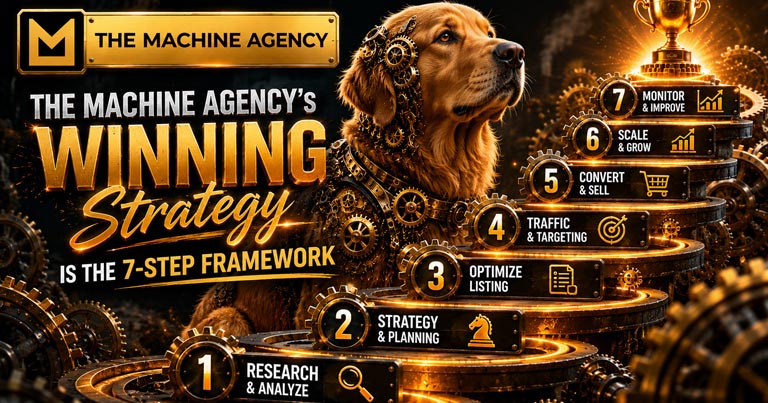
        The Machine Agency’s WINNING Strategy is the 7-step framework behind $40MM+ in client sales on Amazon and Walmart. Here is how it works and why it produces consistent results.

        Every agency has a process. Not every agency can show you exactly what that process produces. At TMA, our process has a name – the WINNING Strategy – and it is the framework behind every client engagement we manage.

        Originally developed from firsthand experience building Amazon brands from the ground up, the WINNING Strategy has since been applied across a growing portfolio of pet and consumer product companies, collectively generating $40MM+ in sales across Amazon and Walmart.

        Here is what each letter stands for and why each step matters.

        W – Watchful Market Analysis

        Before we launch or scale any product, we conduct deep market analysis to understand the full competitive landscape. Keyword demand, competitive pricing, category revenue potential, underserved niches – we map all of it before a single dollar is spent on advertising or inventory.

        The goal is simple: enter the market with data, not guesswork.

        I – Innovative Optimization

        Once a product enters the marketplace, every element of the listing is optimized for discoverability and conversion. SEO-driven titles, high-conversion images and video, A+ Content, Brand Story, and listing structures aligned with Amazon’s AI algorithm – including Rufus.

        The objective is to turn traffic into sales at the highest possible rate.

        N – Nuanced Advertising

        We treat advertising as a data engine, not just a traffic source. Every campaign is built with intent: controlled ACoS, optimized ROAS, conversion-focused targeting, and disciplined keyword harvesting. We manage Sponsored Products, Sponsored Brands, Sponsored Display, and Amazon DSP – and we actively optimize all of them, not just set them and forget them.

        N – Network Growth

        Winning on Amazon requires more than great listings and smart ads. We help brands build a network that strengthens visibility and authority both on and off the platform – through influencer collaborations, off-Amazon marketing, affiliate programs, and strategic partnerships.

        Amazon’s algorithm rewards external traffic. We help brands capitalize on that.

        I – Integrated Technology

        Technology is built into every step of the process. Advanced advertising management tools, data analytics platforms, automation for bid management and reporting, and cross-channel inventory systems ensure our clients operate smarter and faster than their competitors.

        N – Navigational Excellence

        Amazon is one of the most complex marketplaces in the world. Policy changes, listing suppressions, Buy Box dynamics, account health flags, inventory complications – any of these can derail a brand overnight. TMA specializes in navigating Amazon’s ecosystem so our clients do not have to learn these lessons the hard way.

        G – Goal-Oriented Strategies

        Every action we take is tied directly to measurable business outcomes. Revenue growth. Profitability optimization. Market share expansion. Long-term brand value. We do not optimize for impressions or clicks in isolation – we optimize for your financial goals.

          Why It Works

          The WINNING Strategy works because it is a system, not a checklist. Each step reinforces the others. Watchful market analysis informs optimization. Optimization improves advertising efficiency. Advertising generates the data that sharpens every subsequent decision.

          Brands that apply this framework consistently and with discipline do not just survive on Amazon – they build defensible, scalable market positions.

          Ready to build your WINNING Strategy? Schedule a free Amazon brand audit at themachineagency.com/free-amazon-audit and let us show you what this framework looks like applied to your specific brand and category.